
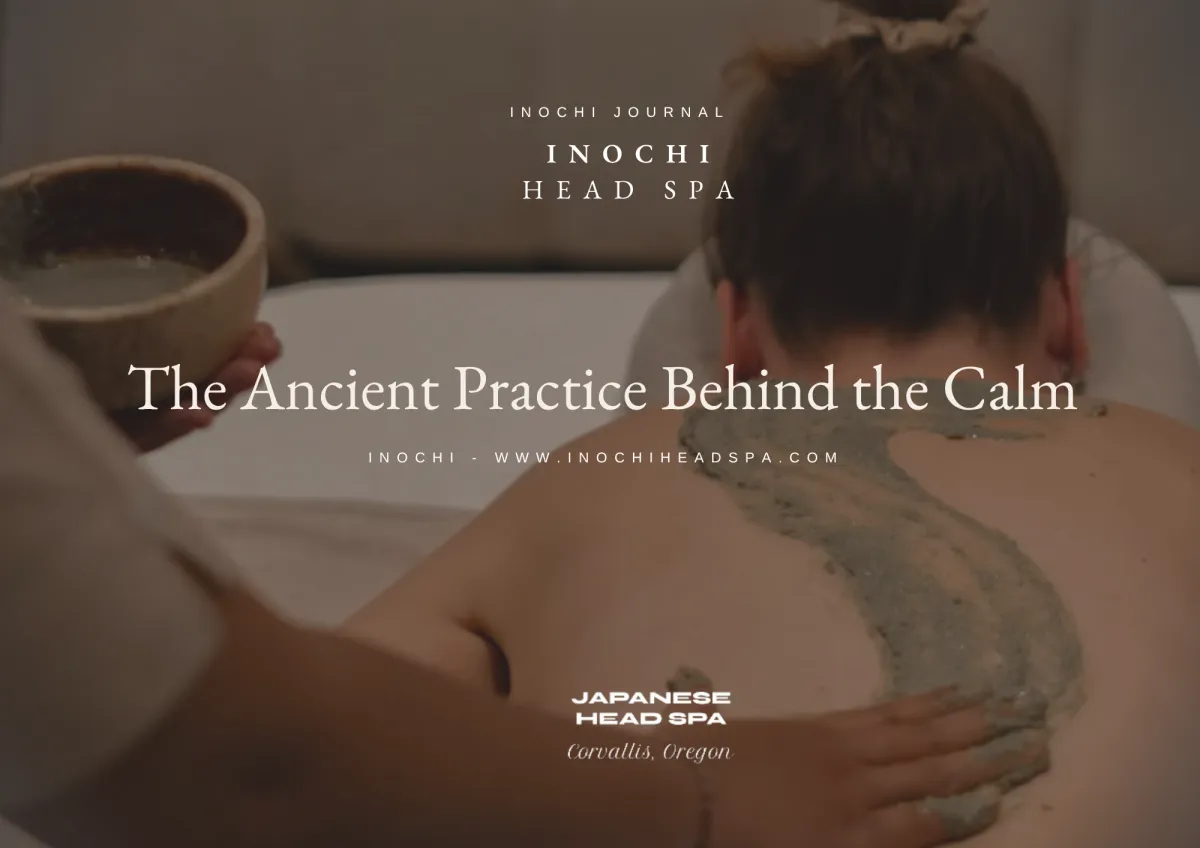
The Ancient Practice Behind the Calm

We live in a world obsessed with what is new. Faster results, newer technology, the next breakthrough, the next thing that promises to fix us a little quicker than the last. So people are sometimes surprised to learn that the heart of Inochi is a ritual thousands of years old.
I understand the surprise. We are taught to believe that newer means better, that progress only moves in one direction. But some things were figured out a very long time ago, quietly perfected over countless generations, and then somewhere along the way we simply forgot them. Part of what I set out to do with Inochi was to remember.
What Shirodhara is
At the center of our signature experience is a practice called Shirodhara. It comes from Ayurveda, one of the oldest systems of healing we know of, and in its simplest form it is a warm, steady stream of oil poured slowly across the forehead. For centuries it has been used for one purpose above all others: to quiet a restless mind.
The name itself tells the story. In Sanskrit, shiro means head, and dhara means flow. A flow, over the head. That is really all it is, and yet it is so much more than that.
There is something about that continuous, gentle stream that the body cannot argue with. It does not ask you to relax. It does not demand that you empty your mind or breathe a certain way or perform calmness the way we so often try to. It simply invites your system, minute by minute, to stop bracing. To come down out of overdrive. To land.
And your body listens. That is the part I never tire of watching. You can almost see the moment it happens, when the shoulders drop, when the jaw softens, when the breath finally deepens on its own. Many people go quiet. Some tear up. Not from sadness, but from finally letting go of something they had been carrying far too long, something they may not have even realized they were still holding.
Many people go quiet. Some tear up. Not from sadness, but from finally letting go of something they had carried far too long.
Rooted in tradition, made our own
I did not want to simply recreate the traditional technique and leave it there. At Inochi, we honor the lineage of this ancient practice deeply, and we also shape it into something that fits the way people actually live now. Wound tight. Overstimulated. Carrying more than their bodies were ever built to hold.
So we keep our roots, and we bring our own care to it. Everything we use is organic and thoughtfully sourced, because what touches your scalp should be as intentional as everything else in the room. Every step is done gently, by hands that have practiced this until it became second nature.
That is what sets Inochi apart from a quick, aggressive scalp scrub. You may have seen the videos out there, people scrubbing at someone's head like they are scrubbing a floor. That is not care, and it is not this. What we do is not about attacking your head. It is about warmth, intention, and the kind of attention that lets your whole nervous system finally feel safe.
Why the old ways still work
Here is what moves me most about all of this.
The practitioners who developed these rituals did not have our modern vocabulary for the nervous system. They did not have the studies or the language we use now to describe what happens when the body shifts out of fight-or-flight and back into rest. But they understood something real about the human body, and about how to bring a racing mind back to stillness. They felt it, refined it, and passed it down carefully across thousands of years so that it could reach a quiet room here in the Willamette Valley.
We are simply fortunate enough to carry that wisdom forward. To be a small part of a very long story.
And I think that is why it works when so many quick fixes do not. It was never a trend. It was never designed to be fast or flashy. It was designed, patiently and over lifetimes, to do one thing well: to help a person come home to themselves.
EXPERIENCE THE RITUAL: Come feel the practice behind the calm. Book at Inochi Head Spa in Corvallis by texting 1 (541) 286-0473.
